
IDN
IDN (Internationalized Domain Name) is a system that allows the use of characters from national alphabets in Internet domain names, such as Czech diacritics. Its goal is to facilitate Internet use in languages that employ characters other than those of the basic English alphabet.
CZ.NIC has long been addressing the issue of IDN.
Survey results
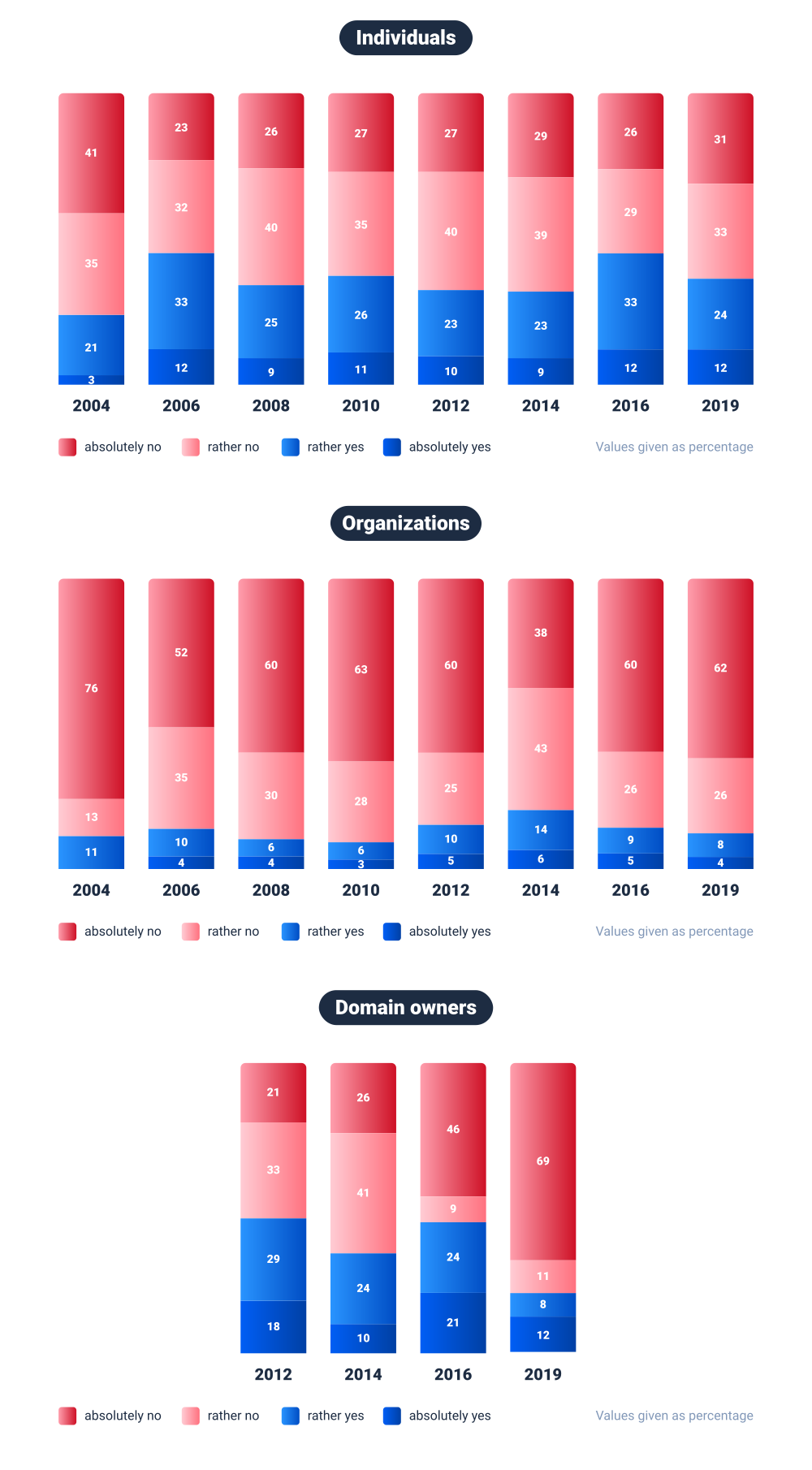
The .CZ domain administrator, the CZ.NIC association, is technically prepared for the potential introduction of IDNs into our national domain. However, it has not yet implemented IDNs for .CZ domains because the Internet user community in the Czech Republic (both individuals and organizations) has not yet shown interest in the introduction of IDNs. CZ.NIC conducts a survey every two years to assess user interest.
The results of the surveys from 2004 to the present are shown in the following graphs (you can view the complete survey results below).
Potentional impacts of IDN implementation
The introduction of IDNs is not a simple matter of allowing the registration of domain names containing accented characters and diacritical marks. It may also bring a number of unintended negative consequences that should be carefully considered when evaluating the adoption of IDNs, whether from a linguistic perspective or in terms of personal security.
The challenges of typing IDN addresses
The primary goal of IDNs is to make domain names available in a form that is natural for users of a particular language. While most users can easily deal with Czech domain names containing diacritical marks, manually entering domain names that use other national alphabets may be considerably more difficult.
Addresses containing special characters or unfamiliar scripts can be difficult to type and remember for users from different linguistic backgrounds. As a result, IDN domain names are most accessible to native speakers of the respective language, while they may present a barrier for others.
How easy is it to type for example: öko.de, różyczka.pl, 艶やかコンパクト.com?
For users unfamiliar with a particular national alphabet, both entering and recognising such addresses may be significantly more difficult—especially if a single character is mistyped or confused with another.
IDNs and cybercriminals
Typos in domain names can be exploited through a technique known as typo-squatting. The principle is simple: domains are registered that differ from well-known addresses by only a minor typo or character substitution. As a result, users may end up on a fraudulent or misleading website instead of the one they intended to visit.
In some cases, such websites may imitate trusted services, such as online banking platforms, in an attempt to obtain login credentials or other sensitive information.
Another risk is posed by so-called IDN homograph attacks. These rely on the use of characters that look identical or very similar but belong to different writing systems. As a result, a domain name may appear trustworthy at first glance even though it leads to a completely different website.
For example:
http://www.gооgle.cz
X
http://www.google.cz
(observe the address displayed in your browser's address bar). In the first example, the character “о” is not the Latin letter “o” but its Cyrillic counterpart.
For example, the letter “o” in a domain name may be replaced by a visually identical Cyrillic character, or similar-looking characters within the Latin alphabet may be confused, such as “l” and “I” or “O” and “0”. Such differences can be difficult to spot and may lead users to fraudulent websites impersonating well-known services..
Registering multiple versions of a domain name
One way to reduce the risk of typo-squatting is to register multiple variants of a domain name—for example, the standard version without diacritical marks, versions with diacritical marks, or the most common misspellings. However, as the number of possible combinations increases, the number of variants grows rapidly, making comprehensive coverage difficult in practice.
Increased risk of legal disputes
Registering a larger number of similar domain names may also create additional complications. The more variations of a name are registered, the greater the likelihood that one of them will conflict with a trademark or another right held by a third party. In extreme cases, this may result in a dispute over the right to use a particular domain name.
How to test your domain
WEB
You can test the following domain names:
To test email functionality, send a test message to testmail@háčkyčárky.cz and enter IDN in the subject line. If everything is working correctly and the message reaches its destination, you will receive a reply. For technical reasons, replies to the same email are sent only once per day.
DNS zone
Here you can find the domain zone file háčkyčárky.cz.
Additional resources
Domain name variations
Here you can try out all the diacritical variations of any .CZ domain name: